Repair
Two days on a walling course
My first attempt at rebuilding a section of real wall, on a beginners’ weekend, and what I got wrong.
I finally did it. After two years of reading about walls and one year of saying I would, I booked a place on a beginners’ weekend run by the local branch of the walling association. Eight of us, one instructor, a farmer who had donated a fallen stretch of field wall to be rebuilt, and two days of mostly dry weather in late July.
This is what happened, as honestly as I can manage, including the bits where I was hopeless.
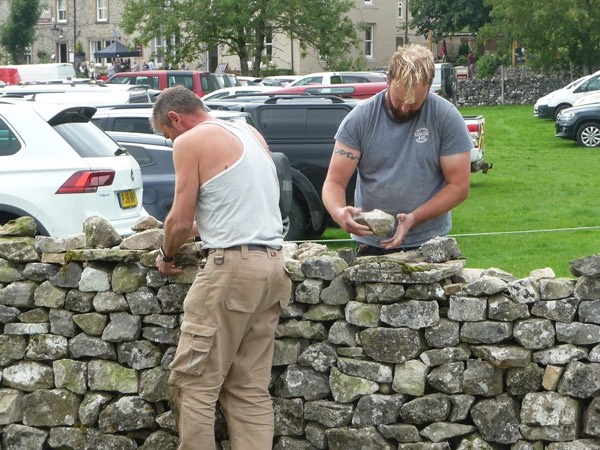
Day one, morning: taking it down
I had assumed we would start by building. We started by demolishing. The gap was about four metres long, where the wall had bellied out and slumped in the winter, and the first job was to take the wall down on either side until we reached sound, undisturbed courses, stepping the ends back so the old wall would not slump into our work.
Every stone was lifted off and sorted as it came down. Copes went in one row, a couple of paces back from the wall on one side. Throughstones were set aside separately, because there are never enough of them. The building stones were laid out in rows by size, biggest nearest the wall, so that the largest would be close to hand for the bottom courses. The small stuff, the hearting, went in a heap of its own.
It took the whole morning and the stone piles took up far more ground than I expected. Our instructor said a rough rule is that you need the stone laid out over a width of a couple of metres on each side of the gap. He also said that sorting is half the job, and I did not believe him until the afternoon.
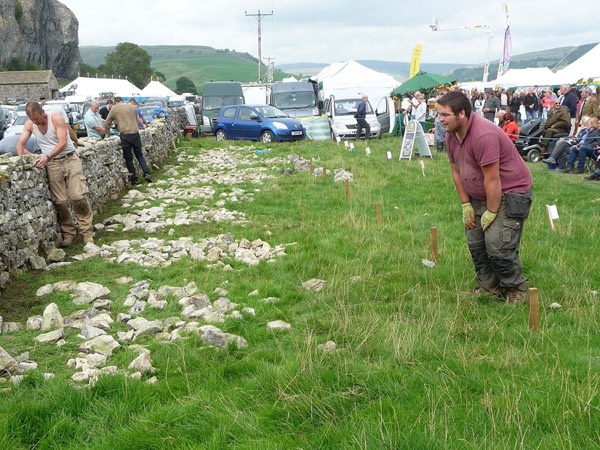
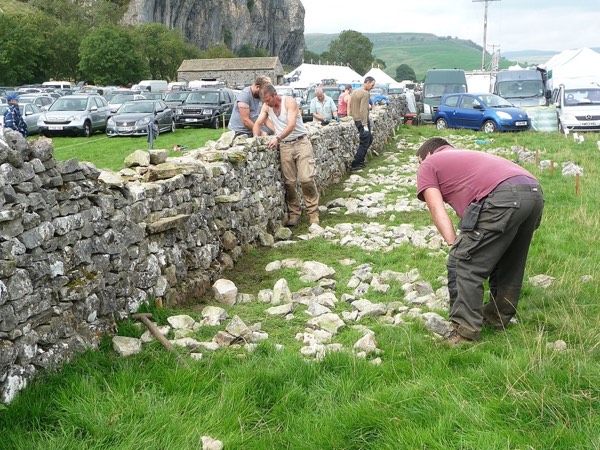
Day one, afternoon: footings and frames
With the gap cleared down to the footings, we checked them. Most were fine and could stay. Two had tipped and had to be reset on firm ground. Then the frames went up: two wooden A-frames, one at each end of the gap, shaped to the profile of the wall, with lines stretched tight between them to mark each face. As each course goes up, the lines are raised, and you build to them. The frames give you the batter, so you do not have to judge it by eye.
My first stones were a disaster. I kept laying them with their long side along the face, because it looked neat and covered more distance, and the instructor kept coming along, picking them out, turning them ninety degrees and putting them back with their length running into the wall. “Face small, length in,” he said, several times, quite patiently. A stone laid lengthwise along the face is called trace walling and it is a weakness. It looks tidy and it will fall out.
Day two: hearting, throughs and copes
The second morning was all about the middle of the wall. For each stone on the face, hearting has to be packed behind it by hand, small stones wedged in so the face stone cannot rock inwards. I had thought this would be the boring bit. It turned out to be the most absorbing part of the whole weekend, a sort of three-dimensional jigsaw where every gap has a stone that fits it if you are prepared to look.
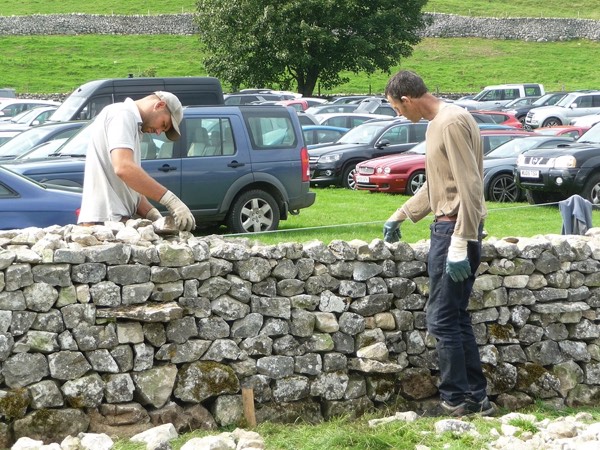
At knee height the throughs went in, long stones across the full width of the wall, and then a couple more courses above them. My partner for the day, a retired engineer called Pete, had a much better eye for stone than me and found a throughstone in the pile that I had walked past six times.
The copes went on in the late afternoon. They are set on edge, packed tight, and the last one at each end is driven in hard to lock the row. Our instructor put the final cope on the end of our section himself, tapped it once with his hand, and said it would do. I have rarely felt so proud of four metres of anything.
What I got wrong
- I lifted with my back on the first morning and paid for it on the second. Bend the knees, keep the stone close, roll the big ones rather than carry them.
- I tried to use every stone in the order I picked it up. You need to look at the space first and then find the stone, not the other way around.
- I left gaps in the hearting where I could not see them, and the instructor found them by pushing on my face stones. They moved. I took that course off and did it again.
- I wore the wrong gloves. Thin gardening gloves last about an hour on gritstone.

Afterwards
I went back three weeks later to look at our section. It was still standing, the frames were gone, and sheep were lying against it in the evening sun as if it had always been there. Our section looked oddly clean next to the old wall on either side: the same stones, but with their weathered, lichen-covered faces now turned inwards in places, and fresh broken faces showing where we had trimmed. Apart from the old copes, there was hardly a lichen to be seen. That will take a while. I have written the date in the notebook so I can check in ten years.