Ferns & wall plants
Ferns in the joints
Wall-rue, maidenhair spleenwort, rustyback and polypody: four small ferns that live in walls, and how to tell them apart without a microscope.
Ferns are the plants that made me start looking at the joints of walls rather than the faces. They are small, mostly evergreen, easy to photograph badly, and they grow in places where it seems impossible that anything could grow at all: a crack between two stones with a pinch of dust at the back of it, facing the wind.
This is a summer post, but most of these ferns look much the same in December, which is part of the appeal.
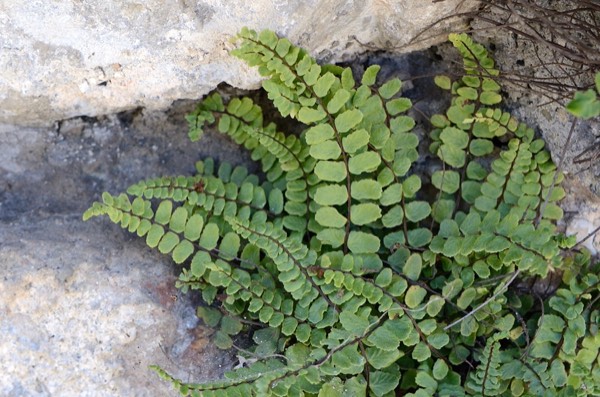
Maidenhair spleenwort
Asplenium trichomanes is the one I see most often, and the easiest to recognise. It grows in neat tufts from a single point in a crack, each frond a narrow strip with a row of small, rounded leaflets on either side of a shiny, dark brown to black midrib. It looks a little like a tiny ladder or a child’s drawing of a fern.
The detail I love is what happens as the fronds age. The leaflets drop off, but the dark midribs stay, so an old tuft has a bristle of bare black wires among the green fronds. Once you know that, you can spot it from several metres away.
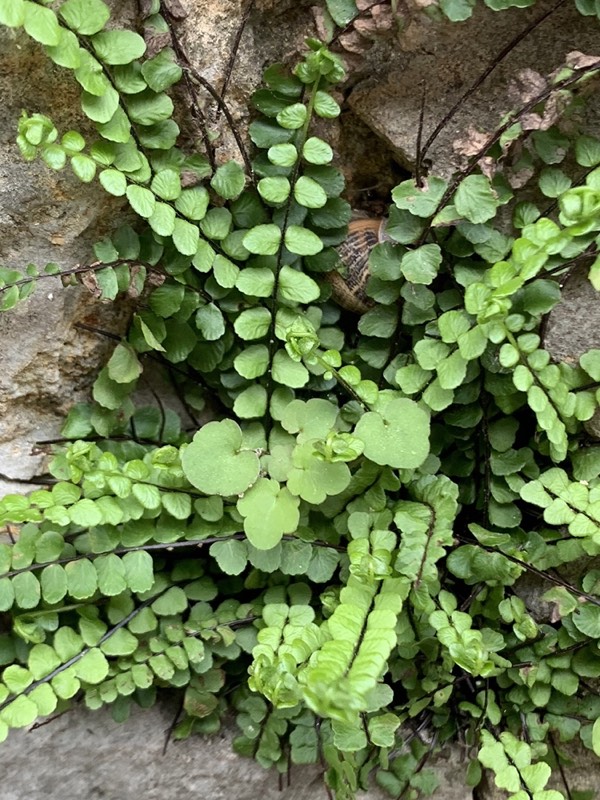
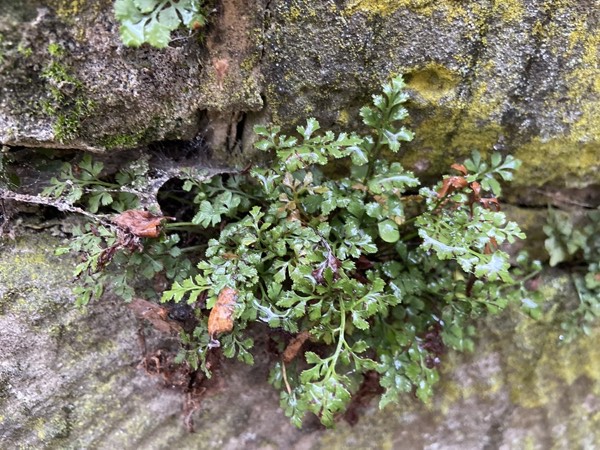
Wall-rue
Asplenium ruta-muraria is smaller and less obviously fern-like. The fronds are short, dull blue-green, and divided into little wedge-shaped or diamond-shaped segments, a bit like a miniature version of the herb rue, which is where the name comes from. It forms low clumps in mortar joints and is strongly drawn to lime, so on dry stone walls you tend to find it on limestone walls, or where there is old lime mortar at a gatepost or the end of a building.
I spent most of one spring thinking a particular clump on a sandstone wall must be something else, until my naturalist friend pointed out the strip of crumbling lime mortar right behind it where a later repair had been pointed. The fern knew before I did.
Rustyback
Asplenium ceterach, often still called Ceterach officinarum in older books, is the one that makes people stop. The fronds are thick and leathery, with rounded lobes running alternately along each side, and the underside is completely covered in overlapping silvery scales that turn a warm rusty brown as they age.
It is a drought specialist. In a dry spell the fronds curl inwards so that only the scaly underside is showing, and the whole plant looks dead, a little brown fist stuck in the wall. After rain it unrolls and turns green again within a day or so. I have watched the same clump do this several times over a summer. It is rarer than the others in my area, and the best patch I know is on a south-facing wall in a sheltered lane, which is the only place I am being deliberately vague about on this site.
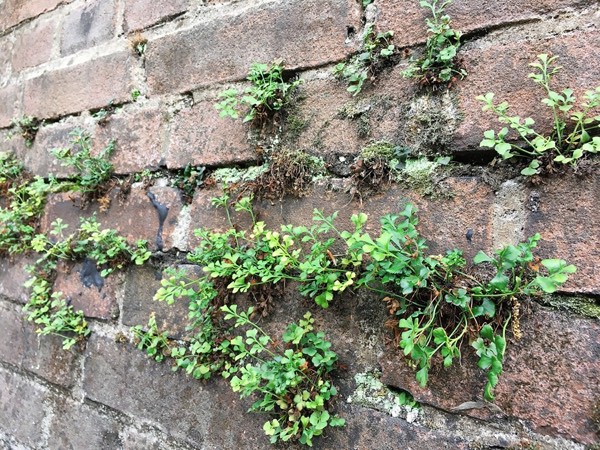
Common polypody
Polypodium vulgare grows on the tops of walls rather than in the joints, along with mossy copes and the bases of trees. The fronds are longer, up to a forearm’s length, simple and comb-like, with a single row of undivided lobes along each side. On the underside, in late summer, there are two rows of round, bright orange-yellow spore clusters, which look almost like sequins.
It spreads by a creeping rhizome that runs along the wall top under the moss, so a stretch of wall in a damp wood can have polypody along the whole length of the copes, like a fringe. Where the wall comes out of the wood into open fields, the polypody stops almost exactly at the edge of the shade.
Brittle bladder-fern and others
On the north side of walls in limestone country, and in shaded, damp places generally, there is a fourth common one I am less sure of: brittle bladder-fern, Cystopteris fragilis, delicate and pale green, more finely divided than the others, the fronds dying back in winter. It is supposed to be easy to recognise, and every time I find one I spend ten minutes convincing myself it is not a young male fern that has seeded into the wall from the hedge.
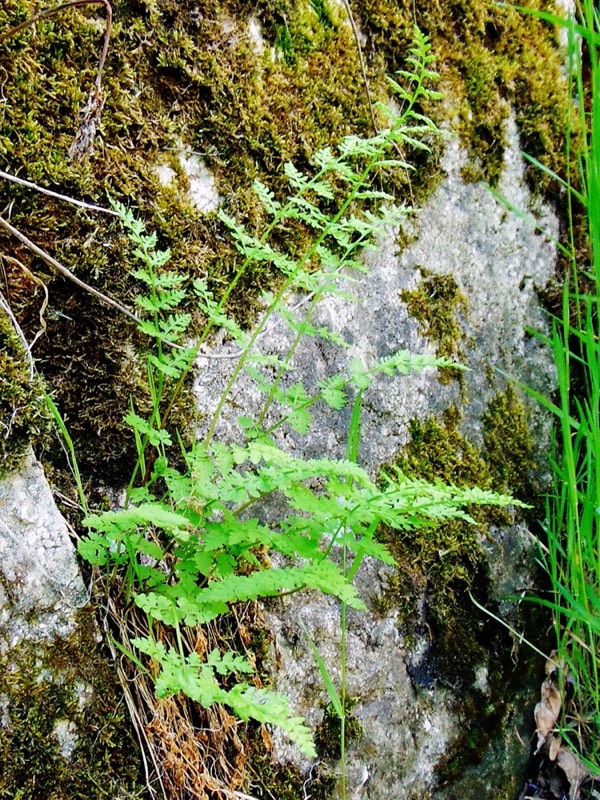
Why walls suit them
Ferns spread by spores, which are dust-fine and travel on the wind. A wall is full of crevices that catch spores and a bit of grit, hold moisture longer than the surface, and are out of reach of grazing animals and lawnmowers. Old walls, with more crevices and more accumulated dust, generally have more ferns than new ones. A rebuilt section might take a decade or more before the first spleenwort appears. I find that encouraging, in a long-term way.