Lichens
The map lichen, and other slow maps
On the yellow-green map lichen, the idea of dating stone by the size of what grows on it, and a few other crusts worth knowing on a gritstone wall.
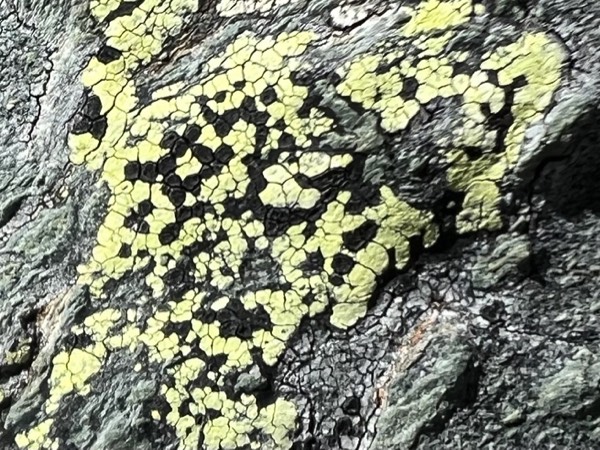
If you look closely at almost any old wall built from hard, acid stone, you will find patches that look like small maps of an archipelago: yellow-green islands packed close together, separated by fine black lines like coastlines or roads. This is the map lichen, Rhizocarpon geographicum, and it was the lichen that made me buy a hand lens.
What you are looking at
A lichen is not one organism but a partnership, usually between a fungus and an alga or a cyanobacterium. The fungus provides the structure and holds on to the rock; the partner makes food from light. In crust lichens like the map lichen, the whole thing is so tightly bonded to the stone that you cannot remove it without taking the surface of the rock with it.
The yellow-green islands are called areoles. The black lines between them, and the black border around the whole patch, are the prothallus, a fungal layer with no algae in it, which spreads out ahead of the colony. Where two map lichens meet, their black borders run into each other and you get a thick dark line, like a border between two countries that do not get on. On some cope stones there are dozens of these colonies jostling, and the whole stone looks like an atlas page.
Dating stone with lichen
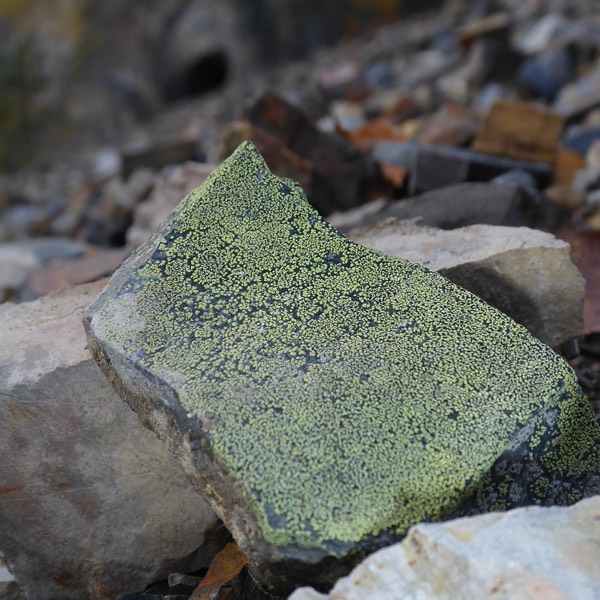
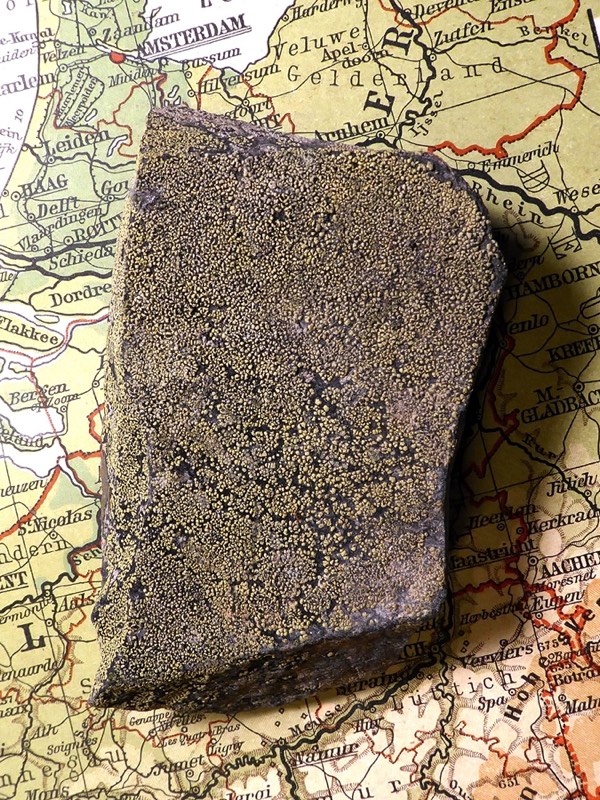
The map lichen grows very slowly, and in a given climate it grows at a fairly steady rate once it is established. Geologists and archaeologists have used this to estimate how long a rock surface has been exposed, by measuring the largest lichen on it and comparing it with lichens on surfaces of known age, such as dated gravestones. The method is called lichenometry, and it has been used on glacial moraines, rockfall debris and old structures.
I am not going to pretend I can date anything with it. The growth rates vary with climate, rock and position, and the published curves are worked out carefully for particular regions. But the idea has changed how I look at walls. On the rebuilt stretch of my practice wall, the map lichens are tiny, a few millimetres across. On the old sections they are several centimetres wide and have merged into big continents. Where a single stone has been turned over during a repair, its old lichen-covered face is now hidden in the wall and its new face is bare. Lichen is a slow clock, but it is a clock.
Other crusts on the same wall
Once your eye is tuned to the map lichen, the rest of the wall starts to separate out into different colours and textures.
There is a pale grey crust with small rims around flat brown discs, which I think is one of the Lecanora species. The discs are the fruiting bodies. Lecanora muralis, in particular, is very common on walls, concrete and even pavements, where it makes greenish-grey rosettes that look like flattened chewing gum until you look closely.
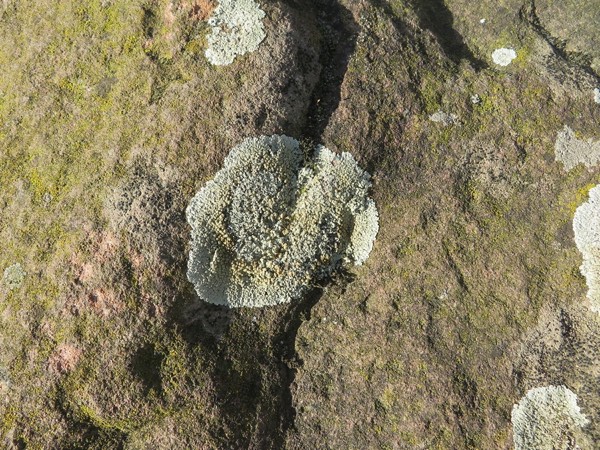
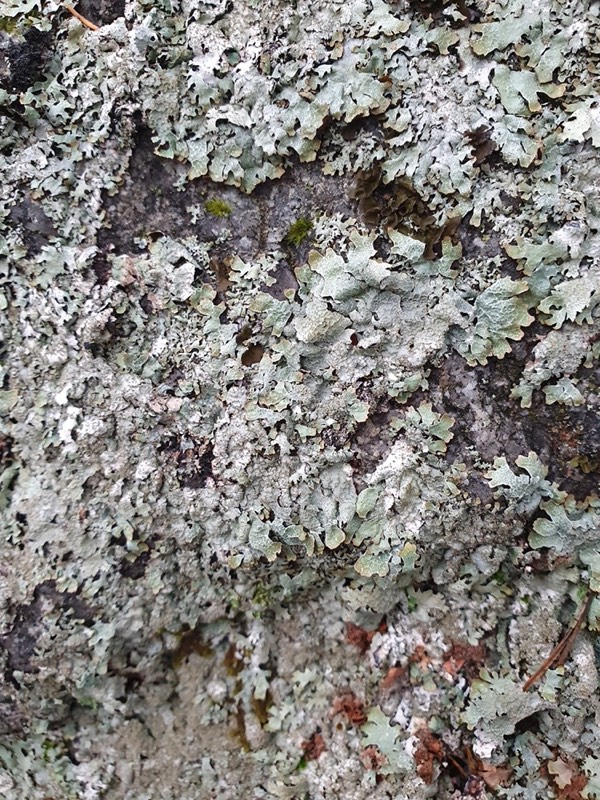
On the tops, where birds perch, there are orange patches, which deserve their own post. On the shaded side there are grey, leafy rosettes that lift slightly at the edges, which are probably Physcia or one of the Parmelia group. And on the oldest stones, in the corner by the gatepost, there is a crottle-like lichen, a grey leafy one with a brownish underside, that was once scraped off rocks in Scotland and Ireland to make a brown dye for wool. I have no intention of scraping anything. It took decades to grow.
A couple of cautions
Lichens are hard to name from photographs, and harder still from a phone screen. Many need a chemical spot test, a microscope, or both, and the experts I have met are cheerfully honest about how often they get things wrong in the field. I have learned to write “map lichen group” rather than a species name, which is accurate and saves embarrassment.
And please do not clean them off walls. People occasionally pressure-wash old field walls or gateposts to make them look tidy. It does not make the wall stronger, and it takes away something that took longer to grow than the wall has been standing.