Walks
Walking the intake wall
A circular walk of about seven miles following the wall that divides the farmed valley from the open fell, and what the wall changes into along the way.
Every valley in the hills has one: the wall that marks the top of the farmed land. Below it are the inbye fields, small, walled, improved over centuries with lime and muck and hay cutting. Above it is the open fell or moor, rough grazing shared by several farms. The wall between the two is usually called the intake wall or the fell wall, and if you follow it you follow the line where people decided, at some point, that the land was no longer worth the effort.
I walked ours on a bright Sunday in early May, with a flask, too many layers, and a notebook that got wet.
The route
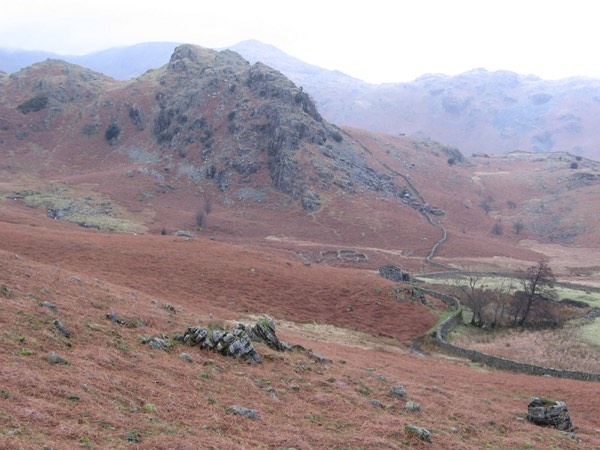
The walk is about seven miles and takes most of a day at my pace, which is slow because I stop at every gap. From the village I took the walled lane that climbs past the chapel, then turned along the bridleway that runs just under the intake wall for most of its length. There are three gates and two stiles. At the far end, where the wall turns down towards the beck, I came back along the valley bottom on the footpath by the river. There is one steep, boggy section near the halfway point where the path has been eroded and you have to pick your own line.
Boots, not trainers. The fell side of the wall is wet in May even in a dry spell.
Old wall, new wall
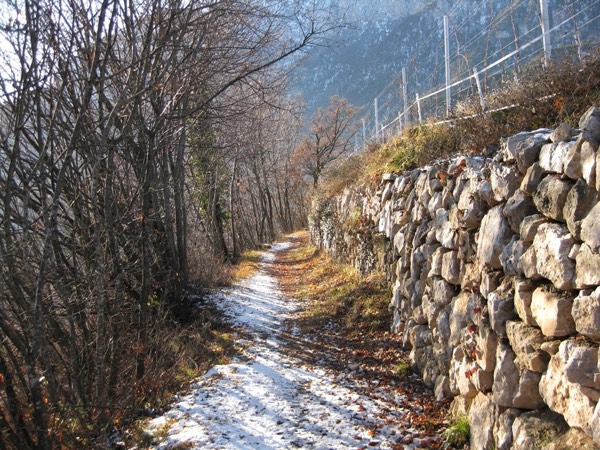
The first thing you notice is that the intake wall is not one wall. Near the village it is an untidy, curving thing, built of rounded stones gathered from the fields, thick at the base, with big boulders built into the footings where they presumably lay too heavy to move. The copes are uneven, and the line wanders around rock outcrops and wet ground as if the builders were following the land rather than a plan. These are, I am told, the older walls, perhaps medieval in their origins, though rebuilt many times since.
Further up the valley the wall changes character abruptly. It becomes straight, regular, built of quarried stone of an even size, and it marches up and over the hill with no regard for the ground at all. This is enclosure walling, built when common land was divided up by legal award, mostly in the late eighteenth and early nineteenth centuries. The straight walls you see running up the fells for miles, dead straight across bog and crag, are nearly always of this date. They were built quickly, often by teams paid by the length, and you can sometimes see where one team’s section ends and the next begins by a change in the throughs or the copes.
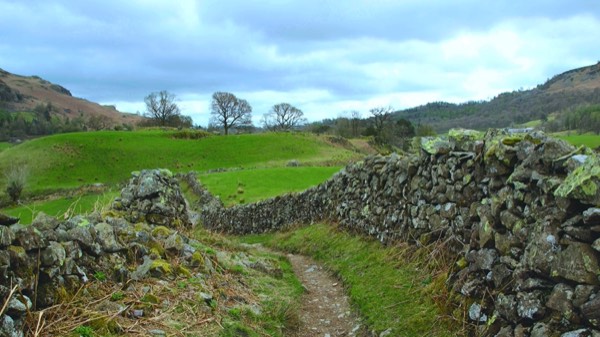
The junction between the two styles is a place I now go out of my way to visit. The old wall stops, there is a slightly awkward bit where someone joined the two, and the new wall heads off up the hill like a ruler.
Things in the wall
At the second gate there is a squeeze stile, two upright slabs set just wide enough apart for a person and not for a sheep. At one point a small rectangular hole at the base of the wall has a flat stone leaning against it, which I think is a sheep creep that has been blocked; it would have let sheep through from one side to the other when the farmer wanted. There is a ruined sheepfold built against the fell side of the wall, a small walled square with a narrow entrance, where flocks were gathered. All three will get their own posts eventually.
Things on the wall
The upper, exposed stretches are grey with lichen and have very little moss except the Grimmia cushions on the copes. Lower down, where the wall runs through a strip of old woodland by the beck, it is completely green: thick mats of moss, polypody ferns along the top, and wood sorrel in the footings. The difference between the two ends of the same wall, built by the same people, is entirely down to shade and moisture.
I counted the gaps on the way round, which is a gloomy habit. Eleven, of which three were recent, with clean unweathered stone showing, and the rest old, grassed over and filled with wire. The wire tells its own story about the cost of walling compared with the cost of fencing.
Practical notes
There is nowhere to buy food on the route, so take it. The bridleway is shared with horses and the occasional mountain bike. In lambing season keep any dog on a short lead and well away from the walls, where ewes shelter. And if you lean on a wall to eat your sandwiches, which everyone does, lean on the copes rather than climbing on them. Copes are heavy, but they are only held in place by each other.