Mosses
Grey cushions: the mosses of one wall
A single stretch of wall, about forty paces long, and the handful of mosses I have learned to tell apart on it.
There is a wall on the lane up to the reservoir that I have been using as a practice ground. It runs east to west, so it has a sunny south face and a damp north face, and the farmer rebuilt about a third of it some years ago, which means it has old stone and newer stone side by side. It is about forty paces from the gate to the ash tree. I have spent more hours on those forty paces than I would like to admit.
These are the mosses I am now fairly confident about. There are others I am not, and they will have to wait.
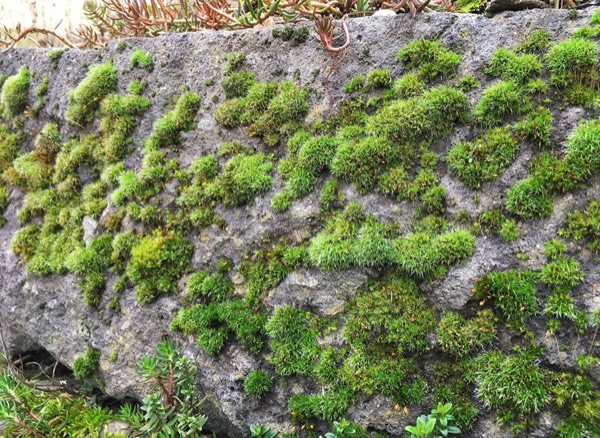
Grey-cushioned grimmia
If you only learn one wall moss, learn this one. Grimmia pulvinata makes small, neat, rounded cushions, about the size of half a golf ball, sitting on top of the copes and the upper courses like something dropped there. When dry they look grey, almost silver, because each leaf ends in a long colourless hair point. When wet they turn a soft green and the hair points become less obvious.
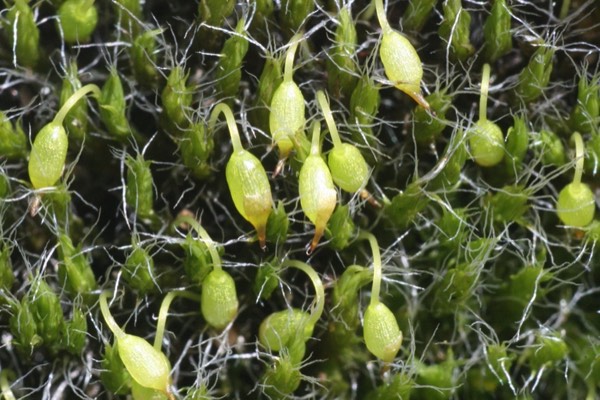
The real giveaway in spring is the capsules. The stalks that carry them are curved, so the capsules hang down and are half buried in the cushion, like a swan tucking its head. Once I had seen that I could pick out Grimmia from the other side of a lane. It likes the sunniest, driest, most exposed tops of walls, which tells you something about how tough it is: a cushion on a south-facing cope in July must get as hot as a stone step.
Wall screw-moss
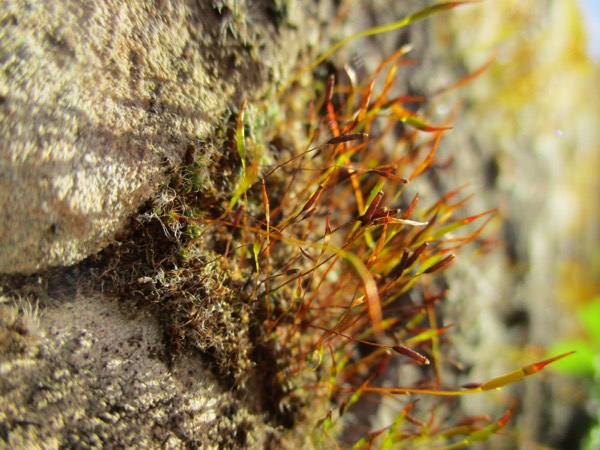
Tortula muralis is the other one you will find almost anywhere, but it prefers mortar, so on a dry stone wall it turns up where there is a bit of lime: a pointed gatepost, the end of a wall where it meets a building, an old repair done with cement. It forms low, untidy tufts with leaves that have a hair point like Grimmia, but the capsules stand upright on straight stalks, reddish at first, and the teeth around the mouth of the capsule are twisted like a corkscrew when you look with a lens. That twist is where the “screw” comes from.
It was the first moss I learned to identify with any confidence, mainly because it grows on the wall at the end of my own street, so I could check it every morning on the way to the bus.
Silky wall feather-moss
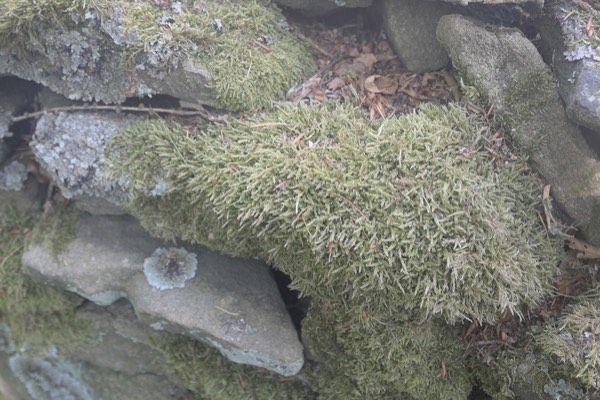
On the north face, lower down, there are glossy yellow-green mats spreading over the stones in sheets. This is Homalothecium sericeum, and it is quite unlike the cushion mosses. It creeps. The shoots are pressed close to the rock, with short branches all along them, and when it dries out the branches curl upwards and inwards, so a dry mat looks like a lot of small hooked fingers. Wet it again and they relax. I have stood and dribbled water from my bottle onto a dry patch just to watch it happen, which a passing dog walker found very odd.
Capillary thread-moss and the rest
Bryum capillare is the one I still hesitate over. It makes soft tufts in the joints, and when dry the leaves twist around the stem like a wrung-out cloth. In spring it carries drooping, pear-shaped capsules that turn from green to brown. It also grows on roofs, tree bases, old tarmac and the bonnet of an abandoned car I once saw, so it is less of a wall specialist than the others.
There is also something dark and low in the gaps on the footings that I think is a Schistidium, but I have been told that the wall species were split into several and that I would need to check the capsule details carefully. So for now it is “Schistidium, probably” in the notebook.
What the forty paces have taught me
Three things, so far. First, that the old and new parts of the wall are very different. The rebuilt section, perhaps fifteen years old, has a few young Grimmia cushions and not much else. The old section has deep cushions, wide feather-moss mats, and layers of lichen beneath. Moss takes its time.
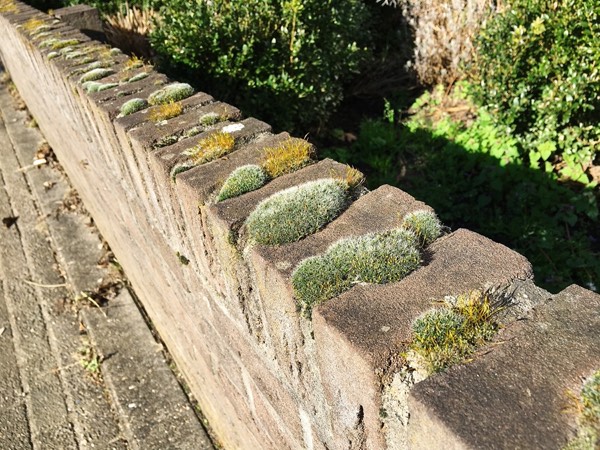
Second, that aspect matters more than I expected. The south face and the cope tops hold the drought-proof cushions. The north face holds the creeping mats. The bottom course, which is often damp and shaded by grass, has its own set again. It is like walking from one hillside to another without moving more than a metre.
Third, that wet days are best. Dry moss is hard to tell apart. After rain, everything opens out and shows its proper colour, and the hand lens stops fogging up because you are already soaked anyway.