Walks
One mile in three hours
An experiment in walking as slowly as possible along a single walled lane, stopping at everything, and writing down only what I actually saw.
Most of my walks are too fast. Even on a slow day, I am thinking about the next stile, the weather, whether I have time to get to the end and back before the light goes. So in April I tried something I had read about in a book on nature writing: pick a short, familiar route, give it a fixed long time, and do not hurry. One mile. Three hours. No destination except the end of the lane.
The lane I chose runs from the last houses of the town up to the gate onto the fell, walled on both sides the whole way. I have walked it perhaps five hundred times. These are edited notes from the notebook.
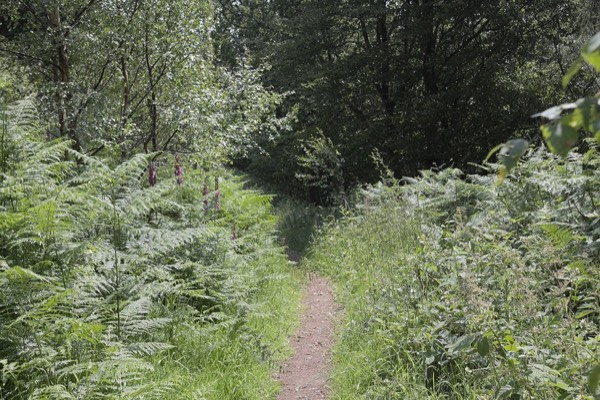
The first hundred metres
Ten minutes in and I had not passed the last house. The garden wall at the bottom has ivy-leaved toadflax in flower, and the first fat queen bumblebee of the year working the dandelions at the foot of it. In a joint at eye level, a single tuft of wall-rue I had never noticed, in five hundred walks. Lime mortar behind it, of course.
There is a cast-iron drain cover set into the verge with the name of a foundry on it. There is a cope stone missing, and in the gap a blackbird’s nest that I did not look at too closely, so as not to disturb it.
The old wall
Past the houses, the walls change to the older field walls. These have Grimmia cushions every few paces along the copes, and today, after a night of rain, they were green and open. I counted cushions on one ten-metre stretch: thirty-one. One of them had capsules ripening on curved stalks, and with a lens I could see the small lid, the operculum, still on top of each capsule. It will fall off when the spores are ready.
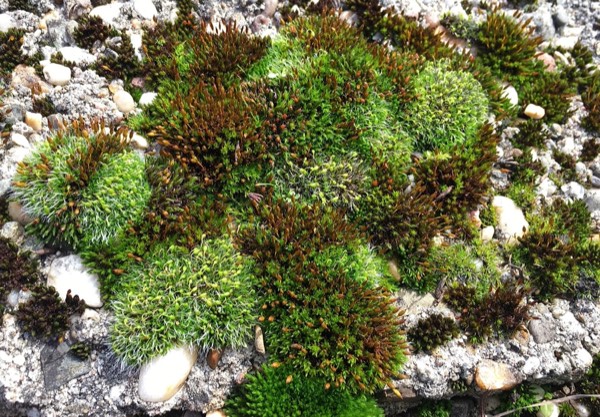
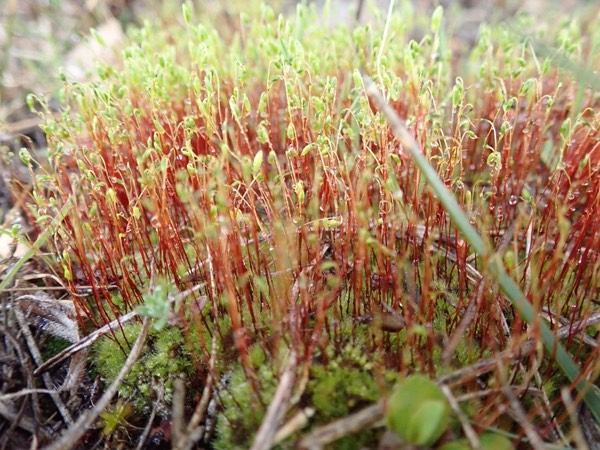
On the shaded side of the lane, the faces of the wall are almost entirely covered in feather-moss and a darker, flatter moss I think is Hypnum. On the sunny side, almost none, only lichen. I knew this already, but standing in the lane between the two faces, turning my head left and right, it was more striking than I had ever allowed it to be.
Twenty minutes on one stone
At about the halfway point there is a large, flat throughstone sticking out of the wall at knee height. I sat down on the verge opposite it and looked at its top surface for twenty minutes, which felt both ridiculous and very restful.
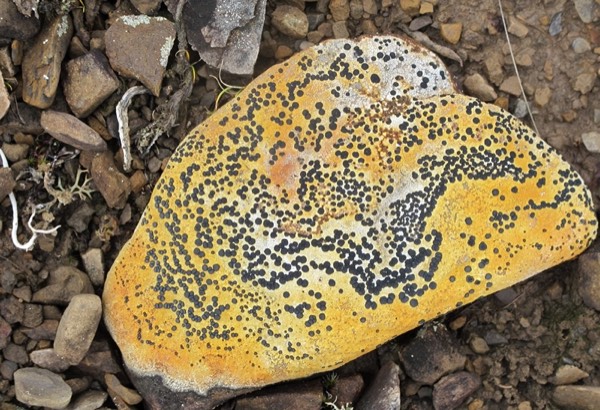
On that one stone, about the size of a tea tray: two colonies of map lichen meeting along a black border; a patch of orange Xanthoria near the edge where a bird must perch; three small grey rosettes, probably Physcia; a scattering of tiny black dots that I think are the fruiting bodies of a crust lichen too small to make out; one Grimmia cushion; a small spider living in a hole under the cushion, who came out twice; and a snail shell, empty, bleached white. I drew it, badly. It is the most I have ever seen on a single stone, and it was only because I made myself stay put.
The wall changes
Higher up, the lane gets steeper and the walls get rougher. There is a section where the wall on the left has slumped into a long belly, still standing but leaning out at an angle that makes you walk on the other side of the lane. There is a gap, older, filled with a rusted iron bedstead, which is a surprisingly common way of mending walls in this part of the world. Brambles have grown through the bedstead and there is a wren’s song coming from somewhere in it.
The gate
I reached the gate onto the fell at three hours and four minutes. I leaned on it for a while. I had written eleven pages, which is more than I usually write in a month.
What I took away
The lane was not different. I was. At walking pace I see walls; at a crawl I see what is on them, and at a standstill I start to see what lives on what is on them. It is the same lane at three different scales, and I have been walking through only one of them.
I will not do this every time. It needs the right kind of day, without wind or rain, and a certain amount of patience that I do not always have. But I am going to do it once a season on the same lane, and compare.