Repair
Mending a frost gap
A wall came down after the January freeze. With the farmer’s permission and a friend from the walling course, we put it back up over two cold Saturdays.
In the second week of January we had nine nights of hard frost followed by two days of heavy rain, and a stretch of wall on the lane I walk most often came down. About three metres, from the copes to the footings, spread across the verge and into the field in a fan of stone. Frost does this. Water gets into the wall, freezes, expands, lifts stones a fraction; then the thaw lets everything settle back slightly differently, and after enough winters a weak section loses its grip all at once.
The farmer, whose sheep were not in that field, said that if I wanted to have a go at it, he would be grateful, as long as it was done properly and I did not block the lane. So Pete, who I met on the walling course last summer, and I put it back over two Saturdays in February.
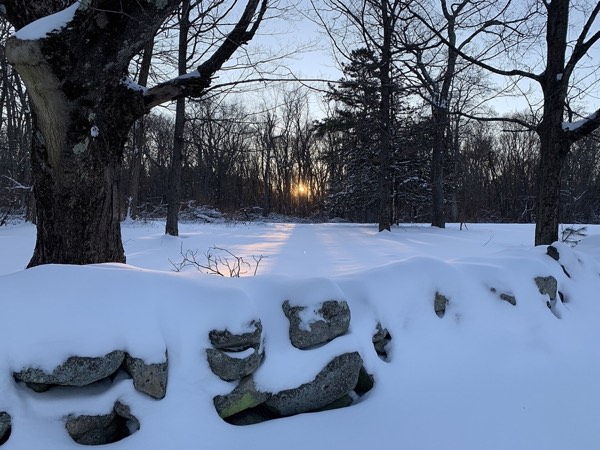
Looking before touching
We spent the first half hour just looking. The gap had a classic shape: wide at the top, narrowing towards the bottom, with the footings still in place. On one side the face had been bulging for a while, and the stones there had slipped outward before the collapse. On the other, the wall was fine right up to the edge of the gap. Behind the bulge there was hardly any hearting left; it had settled down into the base over the years, leaving the face stones with nothing behind them. That was almost certainly the cause.
We also found, in the rubble, two throughstones broken clean in half. Frost again, I think, or just age. They had to be replaced with two long stones from a pile at the field corner, which the farmer said we could use.
Taking it down to sound wall
Following what we had been taught, we took the wall down on both sides of the gap until we reached stones that did not move when pushed, stepping each side back so the remaining wall had a stable end. That made the gap nearly five metres long instead of three, which felt like going backwards. It always does, apparently.
Stones were sorted into rows on the field side, out of the lane: copes, throughs, big building stones, smaller building stones, hearting. Pete is meticulous about this and I have stopped arguing with him.
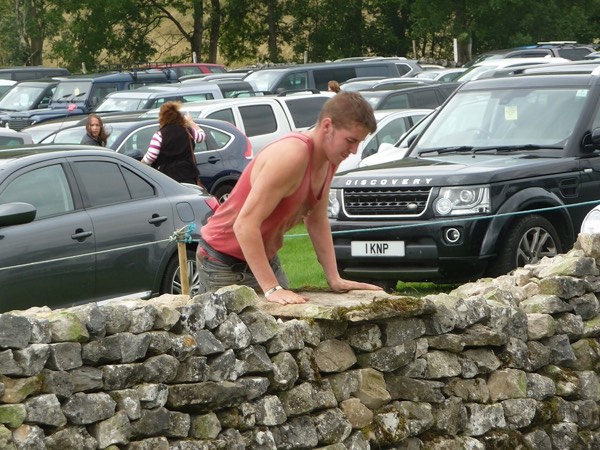
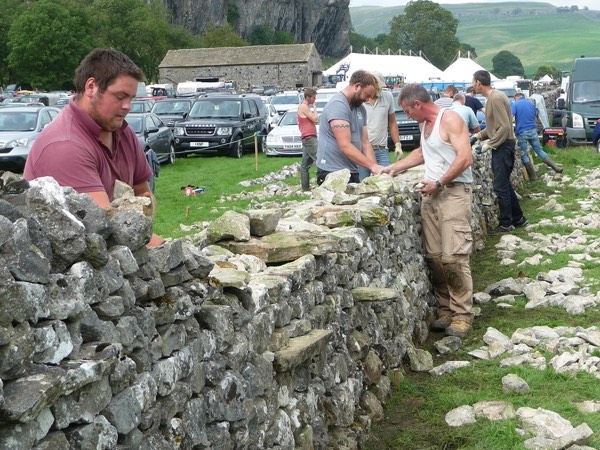
Building
We had borrowed a pair of frames and set them at either end of the gap, shaped to match the profile of the surviving wall, and ran lines between them. The surviving wall had a fairly steep batter, so we set the frames to match it rather than to what we had been taught on the course. A repaired section should look like the wall it is part of.
Day one got us up to the throughs. It was cold enough that my hands stopped working properly after about an hour, and we took a lot of breaks for tea from a flask, sitting on the cope pile. A few walkers came past and stopped to ask what we were doing. One man told us at some length that his grandfather had been a waller and that we were doing it wrong. He did not say which part.
Day two, a week later, was the top half, and the copes. The copes on this wall are rough, rounded stones set upright, and they had all come down intact, so we put them back on in roughly their original order, which we had kept in the row on the ground. The last one was driven in tight at the end with a wooden mallet.
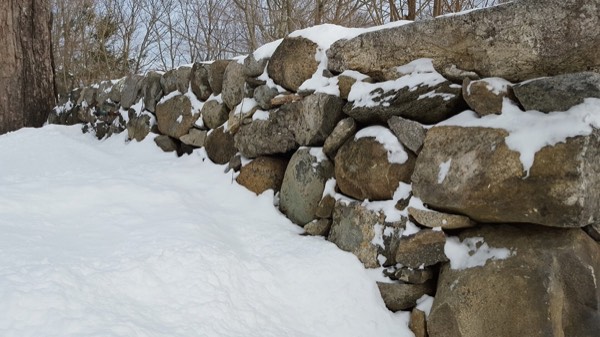
What I noticed this time
- It was faster than the course. Not fast, but faster. I spent less time picking stones up and putting them down again.
- Hearting matters more than anything. We used every scrap we had and could have used more. Next time I will bring a bucket of small stone from the field corner at the start.
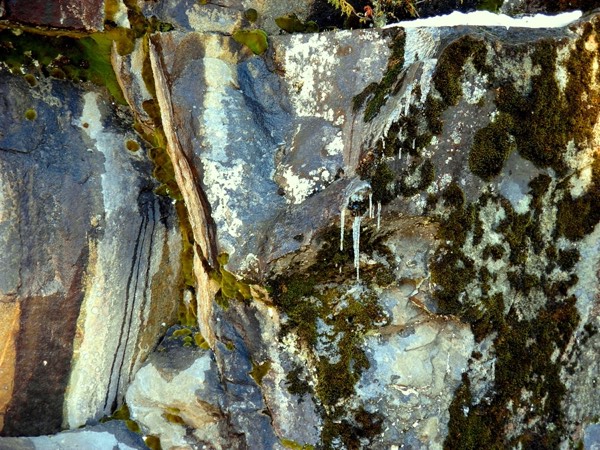
- Old faces should face out. We tried to put each stone back with its weathered, lichen-covered face outwards where we could. The mended section looks less raw than our course section did, and the mosses on those faces should carry on growing.
- Cold is a bigger problem than weight. Two pairs of gloves, and a hot drink every hour.
A month later
It is still up. The sheep were put in the field last week, and two of them were lying against the mended section yesterday, which I am choosing to take as approval. The Grimmia cushions on the replaced copes are a little battered but alive. I have marked the section in the notebook with the date, a sketch, and a note of which two throughs are new, so that one day I can see whether lichen grows faster on the fresh stone or the old.