Walls & walling
Leaf fall on the copes
A short autumn post, almost two years into the notebook: what has changed on the walls I watch, and what has not.
The ash tree at the end of my forty paces of practice wall has dropped its leaves this week, all at once, the way ash trees do. For a day or two the copes were covered in them, small yellow-green leaflets lying on the moss cushions like confetti. Then the wind took most of them into the field, and the wall was back to grey and green.
It is almost two years since I started this notebook, so I spent a long, damp Sunday walking my usual walls and comparing them with what I wrote at the beginning.
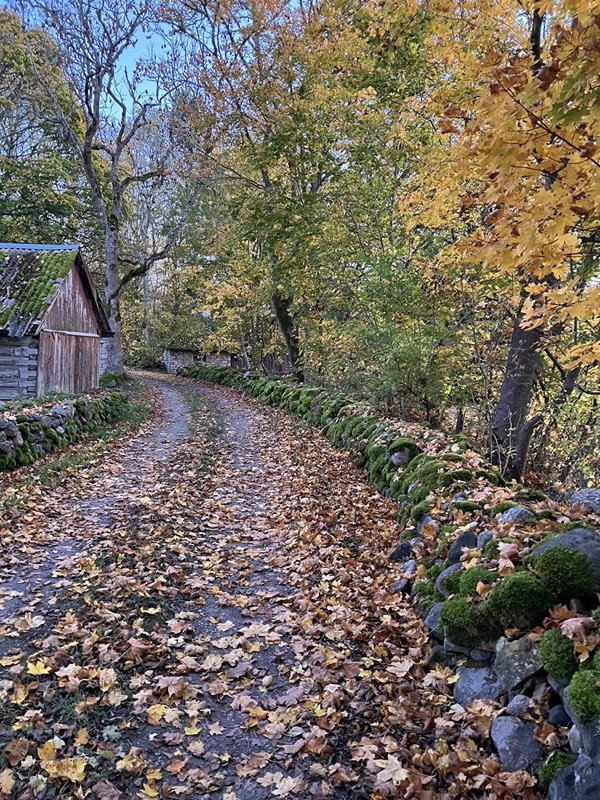
The practice wall
The Grimmia cushions on the copes are, as far as I can tell, exactly where they were. I have a sketch from March last year of one particular cope stone with five cushions on it, and there are still five, one of them noticeably bigger. The silky feather-moss on the north face has spread along two more stones. A cushion that I thought was dead last summer, completely grey and crumbling, has a green edge again. I had written it off too soon.
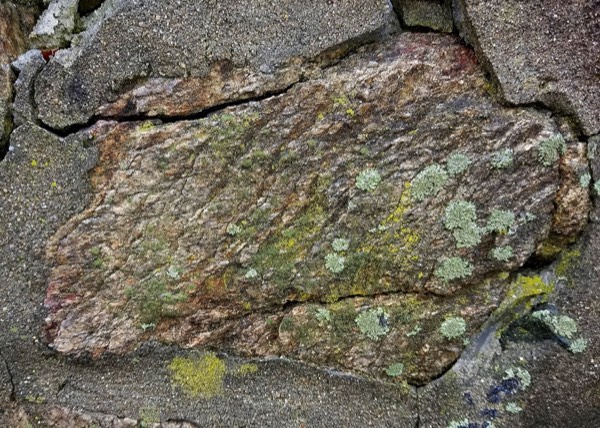
The orange lichen on the cope by the gate looks the same, and so does the map lichen. Two years is nothing to a lichen. I did not really expect to see a change, but it is still a slightly humbling thing to measure: two years of my life, no measurable difference on the stone.
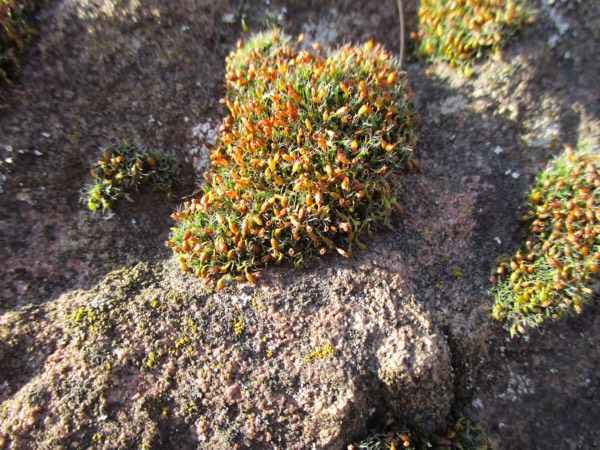
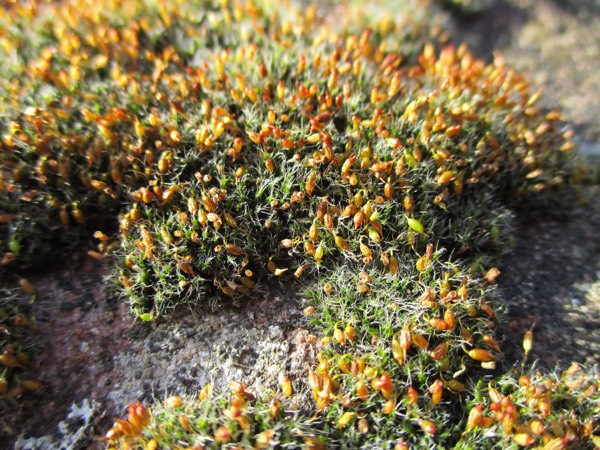
The course section
Our rebuilt stretch from the walling course in the summer of last year is still standing, still straight, and no longer as obviously new. The fresh broken faces of stone have greyed a little. On the copes, which we put back from the original wall, the old cushions and lichens are carrying on. On the new faces lower down, there is a faint green film of algae on the north side and, in two places, the first tiny tufts of moss, so small I needed the lens to be sure. I wrote the date beside them in the notebook with an exclamation mark, which I do not often use.
The frost gap
The section Pete and I mended in February is fine. One cope had worked loose, probably knocked by a sheep or a walker leaning, and I pushed it back in and wedged it with a sliver of stone. That is the whole of wall maintenance, I am learning: walk past often, notice small things, fix them before they become big things. A wall that is walked regularly by someone who cares about it lasts longer than a wall that is not.
What has changed in me
More, I think, than on the walls. Two years ago, a wall was a grey line between fields. Now it is footings, faces, hearting, throughs and copes; a date, roughly, and a style; a set of mosses on its north face and a different set on its south; a map of where the birds perch and where the fertiliser falls; and a record of the people who built it, mended it, blocked its creeps, and put iron bedsteads in its gaps. I cannot walk past one without stopping, which has made my walks much slower and, I think, much better.
What comes next
More of the same, I hope. I want to learn the crust lichens properly, which is probably a ten-year project. I want to do another stretch of repair with Pete if the farmer will have us back. I want to walk the long enclosure wall that runs over the top of the moor to the next valley, all of it, in one day, in spring. And I want to keep the slow walks going, once a season, on the same lane.
Thank you for reading, whoever you are. If you have a wall near you, go and look at the top of it. There is almost certainly something growing there that has been there longer than you have been walking past.
— Maren