Walls & walling
Folds, pinfolds and bields
The small stone enclosures and shelters that sit among field walls: sheepfolds for gathering, pinfolds for strays, and curved walls built only to break the wind.
Not every wall is a boundary. Scattered across the hills, often in odd corners, there are small walled structures that are not fields at all: circles, squares, crosses and curves of stone built for handling animals or sheltering them. Most of them are no longer used, and some are half buried in bracken, but once you know the shapes you start finding them on every walk. This summer I went looking for as many as I could.
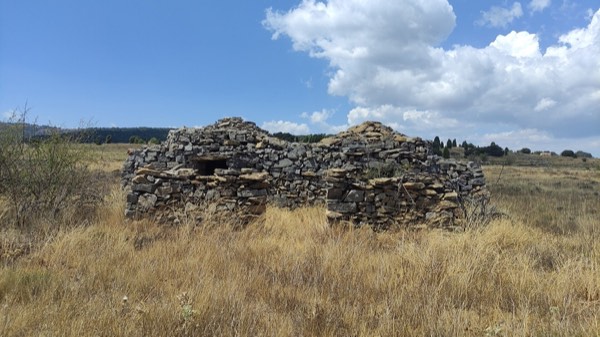
Sheepfolds
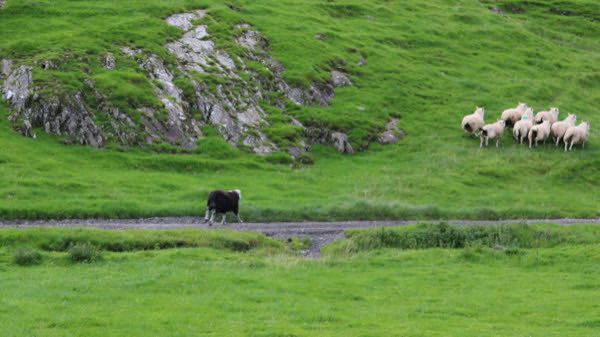
A sheepfold is an enclosure where sheep are gathered from the open fell for counting, shearing, dipping, sorting or marking. On the fells they are usually built against an intake wall or in a sheltered hollow near a stream, with high walls and a single narrow entrance. Some are a single pen; others are a cluster of pens of different sizes, connected by gaps, so a flock could be driven in and then split up.
The ones I know best are on the open side of our intake wall, three of them along a couple of miles, each by a small beck. Two are ruined, walls down to knee height and full of nettles, which grow so well in old folds because of centuries of dung. The third is still used in summer for gathering, and the farmer has patched it with hurdles and a steel gate. Inside it, the turf is the greenest grass for a mile around.
Some folds have a washfold beside them, where a stream was dammed to make a pool for washing sheep before shearing. I have found the remains of one, a pair of low walls on either side of a beck with a gap where boards would have slotted in, and I only knew what it was because an older farmer told me.
Pinfolds
A pinfold, or pound, is a small, usually round or square walled enclosure, typically in or near a village, where stray animals were impounded. In the past, an animal found wandering on the common or in someone’s crops could be taken to the pinfold by the pinder, an officer of the manor or parish, and the owner had to pay a fine to get it back.
There is a restored one at the edge of a village in the next valley, a circle of stone perhaps eight metres across with a single gate. It has a small plaque and a bench. It is a quiet place to sit, and I enjoy the thought of generations of furious owners arriving to pay for their escaped pigs.
Bields
The structure that interests me most is the simplest: the bield, a shelter wall. On exposed hillsides you sometimes find a short curved wall standing on its own, or a cross of four short walls meeting at the middle, out in an open field or on the fell. They enclose nothing. Their only job is to give sheep somewhere to stand out of the wind and snow, whichever way it blows. With a cross-shaped bield there is always one sheltered corner.
I found a cross-shaped one on a high pasture in July, on a day when there was a strong westerly. I sat in the east-facing angle of it with my flask and could have been indoors. A few metres away, in the open, my map was being torn out of my hands.
Other bits
Around the folds and walls there are other small things. Stone troughs, cut from a single block, for water. Mounting blocks by old gateways. Small stone huts in the corners of fields, sometimes no bigger than a cupboard, which may have been shelters for shepherds or stores; I am not sure, and the people I have asked are not sure either. Clearance cairns, heaps of stone in the middle of a field, which might be ancient or might be from the last time someone cleared the ground.
Finding them
Older large-scale maps mark many sheepfolds and some pinfolds, often simply as “Fold” or “Sheepfold” in small italic type, and they are good targets for a walk. Many are on open access land and can be visited freely; some are on private farmland and should be looked at from a path. If a fold is in use, with sheep in it or a farmer working, it is not the moment to visit.
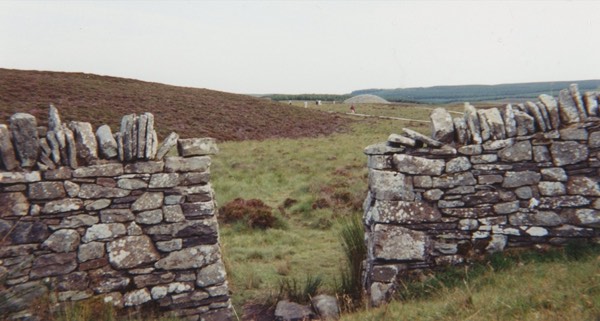
What I like about all these structures is that they are walls doing other jobs. The same stone, the same technique, the same two faces and hearting, bent into circles and crosses for counting and sheltering and holding. The craft is the same. Only the shape changes with the need.